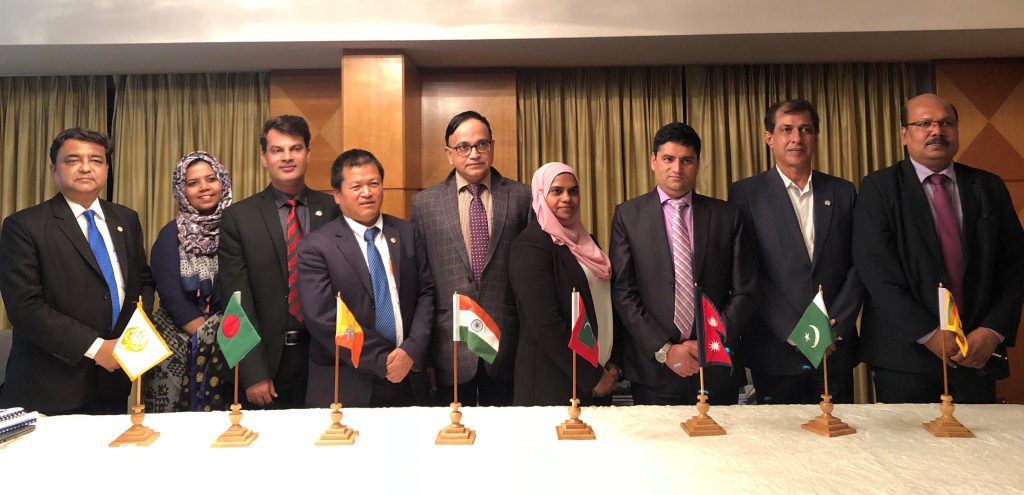
Colombo, Sri Lanka 23-24 August 2019 – SAARC Development Fund held its 31st
Board Meeting in Colombo, Sri Lanka this week taking decisions on key
issues to further promote regional integration and economic cooperation
among its eight Member States.
Two
projects – Consortium for scaling up climate-smart agriculture in South
Asia and the Second phase of Inter-professional Master’s Programme in
Rehabilitation Science – were approved.
The
Project – Consortium for scaling up climate-smart agriculture in South
Asia – with International Fund for Agriculture Development (IFAD) and
through SDF’s funding will promote sustainable and resilient
agricultural intensification in Afghanistan, Bhutan, Pakistan, and Sri
Lanka through enhanced Climate-Smart Agriculture (CSA) capacity and
technologies. The project will be implemented by National Agricultural Research and Extension Systems (NARES) and SAARC Agricultural Centre (SAC).
CEO
of SAARC Development Fund Dr. Sunil Motiwal said that this project
worth USD 3.32 million will directly benefit over 7,500 smallholder
farmers as well as researchers, extension workers, and policymakers in
Afghanistan, Bhutan, Pakistan, and Sri Lanka.
“Impacts
of climate change are felt across South Asia and we believe that there
is a need to enhance the adaptive capacity of smallholder farmers,” he
said.
Smallholders will
participate in the validation of CSA technologies and will benefit from
training, exposure visits, and knowledge events. Hence overall, more
than 100,000 smallholders will benefit indirectly from the development
of strategies for scaling up CSA technologies. This is in addition to
IFAD’s approved regional grant to support the launch of C-SUCSeS in
Bangladesh, India, and Nepal.
The second project approved by the Board – Second phase of Inter-professional Master’s Programme
in Rehabilitation Science for USD 1.5 million– will develop highly
qualified professionals in the area of Rehabilitation Science to enable
the provision of quality rehabilitation policies and services to people
with disability in all the eight SAARC Member States. The Masters
Programme is offered at the Bangladesh Health Professions Institute
(BHPI), Centre for the Rehabilitation of the Paralysed (CRP).
Through
this project, there will be 150 Direct Beneficiaries, 660 graduate and
undergraduate students as secondary beneficiaries annually, and 234,432
patients or the disabled or people with chronic health conditions per
year as ultimate beneficiaries.
The
SAARC Development Fund, since its inception in April 2010 by heads of
the eight SAARC Member States, is mandated to build regional integration
and economic cooperation through project funding in all the SAARC
member states – Afghanistan, Bangladesh, Bhutan, India, Maldives, Nepal,
Pakistan, and Sri Lanka. The Secretariat is based in Thimphu Bhutan.
SDF’s
governance structure includes its Governing Council comprising of the
Finance Ministers of the eight SAARC Member States, and its Board of
Directors comprised of representatives from the Ministry of Finance of
each Member State. The SDF Secretariat, located in Thimphu, Bhutan, is
headed by Chief Executive Officer.
SDF has an authorized capital of USD 1.5 Billion and a total capital base of USD 511.52 Million. Currently SDF is implementing 80 projects (12 areas) under its Social Window funding scheme with fund commitment of USD 73.74 million and two more projects are approved in principle in social sector,
5 projects under the Economic and Infrastructure windows (including 2
in-principle approved projects) with a fund commitment of USD 73 million
and MSME Program with fund allocation of USD 50 million in SAARC Member
States. The cumulative fund commitment under the three funding windows
including MSME Program stands at USD 197.4 million.
“Further, more
than 10 bankable projects including projects in Sri Lanka are also
under active consideration of SDF to co-finance in the SAARC Member
States,” said Dr. Sunil Motiwal.
Categories